
Success in Forex trading goes far beyond having a solid strategy or sharp instincts. In a fast-moving and emotionally demanding market, one of the most powerful tools a trader can use is a Forex trading journal. A well-maintained trading journal allows you to analyze past trades, identify patterns, control emotions, and continuously refine your strategy.
This comprehensive guide explains why keeping a Forex trading journal is essential, what to include in it, how to maintain it effectively, and how it can transform your long-term trading performance.
Introduction to Trading Journals
A trading journal is a detailed record of every trade you take, including entry and exit points, position size, market conditions, reasoning behind the trade, and your emotional state throughout the process. Unlike a basic trade log, a trading journal focuses not only on what happened, but why it happened.
For serious Forex traders, a journal is an essential tool for structured self-evaluation and continuous improvement. It creates awareness of your habits, strengths, and weaknesses, helping you make more informed decisions over time.

Why Keeping a Trading Journal Is Important
Reviewing and Analyzing Past Trades
One of the most valuable benefits of a trading journal is the ability to review and analyze past trades objectively. By documenting your decisions, you can determine what worked, what didn’t, and why.
Example: If you notice that trades taken during high volatility consistently result in losses, you can adjust your strategy to avoid those conditions.
Identifying Patterns and Trends
Over time, your trading journal will reveal recurring patterns in both winning and losing trades. These patterns may relate to market conditions, timing, setups, or emotional behavior.
Example: You may discover that fear of missing out (FOMO) causes you to enter trades too early, leading to avoidable losses.
Building Discipline and Emotional Control
Writing down each trade increases accountability and encourages disciplined decision-making. Tracking emotions helps you understand how fear, greed, or overconfidence influence your actions.
Example: Regularly noting emotional states before and after trades helps you recognize when emotions are driving decisions instead of logic.
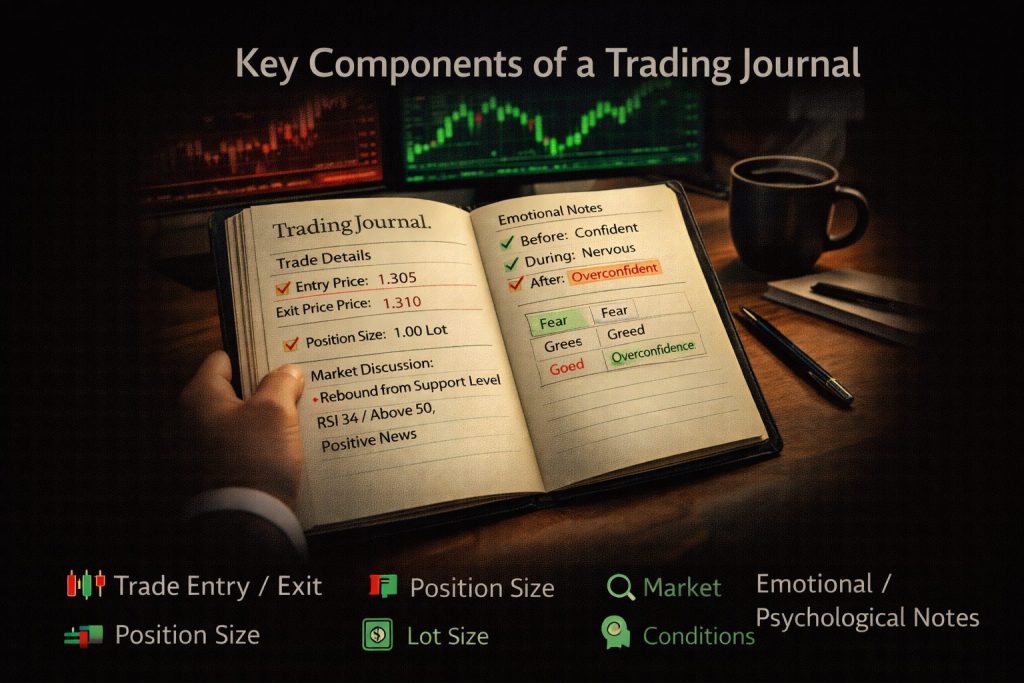
Key Components of a Forex Trading Journal
Trade Details: Entry, Exit, and Position Size
Each journal entry should include:
- Entry price and exit price
- Position size
- Date and time of the trade
These details allow you to evaluate timing, risk management, and execution accuracy.
Market Conditions and Analysis
Record the market context and analysis behind each trade:
- Market environment (trending, ranging, volatile)
- Indicators or tools used
- Fundamental or technical reasoning
This helps identify which conditions favor your strategy.
Emotional and Psychological Notes
Document how you felt before, during, and after the trade:
- Confidence or hesitation before entry
- Emotional reactions during the trade
- Feelings after closing the position
This is critical for improving trading psychology.
Lessons Learned and Areas for Improvement
Conclude each entry with reflection:
- What went right
- What went wrong
- Adjustments to apply in future trades
Every trade becomes a learning opportunity.

How to Create and Maintain a Trading Journal
Choosing a Format: Digital vs. Paper
Both formats are effective:
- Digital journals (spreadsheets or apps) are easier to analyze and organize.
- Paper journals encourage deeper reflection and mindfulness.
Choose the format that best fits your personality and workflow.
Structuring Entries for Maximum Benefit
Use a consistent format for every trade. Separate sections for trade data, analysis, emotions, and lessons make reviewing easier and more effective.
Tip: Consistency allows meaningful comparisons across trades.
Reviewing and Updating Regularly
A trading journal is only valuable if reviewed regularly. Set aside time weekly or monthly to analyze performance, identify trends, and refine your trading plan.
Tip: Treat review sessions as growth opportunities rather than judgment.

Advantages of Keeping a Forex Trading Journal
Continuous Strategy Improvement
By analyzing journal data, you can eliminate ineffective setups and focus on high-probability trades.
Example: If certain entry signals consistently perform better, you can prioritize them.
Building Confidence and Accountability
Knowing that every trade must be justified in writing discourages impulsive decisions and reinforces discipline.
Avoiding Repeated Mistakes
A trading journal highlights recurring errors, allowing you to correct them before they become costly habits.
Example: Recognizing losses from counter-trend trading helps you avoid similar setups.
Case Studies: How Trading Journals Transform Performance
Case Study 1: A Day Trader’s Journey to Consistency
A day trader struggling with inconsistency began journaling trades daily. Over time, the journal revealed emotional overtrading during volatile sessions. By limiting trades and sticking to a plan, consistency improved significantly.
Case Study 2: Turning Around a Losing Strategy
Another trader identified overconfidence as the root cause of losses after reviewing journal entries. By trusting analysis instead of emotion, the trader reversed a prolonged losing streak.
Common Mistakes to Avoid When Keeping a Trading Journal
Incomplete or Inconsistent Entries
Missing details reduce the journal’s effectiveness.
Solution: Record every trade fully, no matter how small.
Ignoring Psychological Factors
Failing to document emotions limits self-awareness.
Solution: Always record emotional states during trades.
Not Reviewing the Journal Regularly
A journal without review provides little value.
Solution: Schedule weekly or monthly reviews.
Conclusion: Stay on Track with a Forex Trading Journal
Maintaining a Forex trading journal is one of the most effective ways to improve consistency, discipline, and long-term performance. By recording trades, emotions, and lessons learned, traders gain valuable insight into their habits and decision-making processes.
Whether you are a beginner or an experienced trader, a well-maintained trading journal helps you learn from mistakes, reinforce positive behaviors, and stay on track toward consistent profitability in the Forex market.
-
What is a Forex trading journal?
A Forex trading journal is a detailed record of every trade, including entry and exit points, market conditions, emotions, and lessons learned. -
Why is a trading journal important in Forex trading?
It helps traders analyze performance, identify patterns, improve discipline, and avoid repeating costly mistakes. -
What should I include in a trading journal?
You should include trade details, market analysis, emotional notes, and post-trade lessons. -
Can a trading journal improve trading psychology?
Yes, tracking emotions and decisions increases self-awareness and helps control fear, greed, and impulsive behavior. -
Is a digital or paper trading journal better?
Digital journals are easier to analyze and organize, while paper journals can encourage deeper reflection. Both are effective. -
How often should I review my trading journal?
Weekly or monthly reviews are recommended to identify trends and improve strategies. -
Do professional Forex traders use trading journals?
Yes, most professional traders rely on journals to maintain discipline and consistency. -
Can beginners benefit from a trading journal?
Absolutely. A trading journal helps beginners learn faster by understanding mistakes and improving decision-making. -
How does a trading journal help avoid repeated mistakes?
By reviewing past losing trades, traders can recognize patterns and prevent repeating the same errors. -
Does keeping a trading journal increase profitability?
While it doesn’t guarantee profits, it significantly improves consistency, discipline, and long-term performance.
