
In the world of Forex trading, position sizing is a critical aspect that directly impacts your risk management and overall trading performance. The concept of “one size fits all” does not apply to position sizing because each trader has a unique account size, risk tolerance, and trading strategy. To optimize your trading outcomes, it’s essential to tailor your position sizing approach to fit your individual needs. This article explores various position sizing strategies, how they can help you manage risk, and the importance of choosing the right strategy based on your trading objectives.
1. Introduction to Position Sizing in Forex Trading
Position sizing refers to the process of determining the number of units or lots to trade in a given position. It is a fundamental aspect of risk management and plays a significant role in defining the potential impact of a trade on your overall account balance. Proper position sizing ensures that you are not overexposed to any single trade, helping to preserve your capital and maintain steady growth.
While many traders focus on entry and exit strategies, position sizing is equally important, if not more so. Even a sound trading strategy can lead to significant losses if not paired with an appropriate position sizing approach. Understanding and implementing the right position sizing strategy can make the difference between success and failure in the Forex market.
2. Why Position Sizing is Crucial for Risk Management
Position sizing is not just about determining how much to trade; it’s about managing risk and ensuring that you can sustain your trading activities over the long term. Here’s why it’s so crucial:
Protecting Your Trading Capital
The primary purpose of position sizing is to protect your trading capital. By sizing your positions correctly, you limit the amount of money at risk on any single trade, reducing the likelihood of catastrophic losses that could wipe out your account.
Example: If you have a $10,000 account and you decide to risk 2% per trade, you would risk $200 on each trade. This means that even if you experience a series of losing trades, your account won’t be significantly depleted.
Enhancing Consistency in Trading Performance
Consistency is key to long-term trading success. By maintaining a disciplined approach to position sizing,
you can smooth out the volatility in your trading performance, leading to more predictable results over time.
Example: A trader who consistently risks the same percentage of their account on each trade is less likely to experience wild fluctuations in their equity curve, making it easier to evaluate the effectiveness of their trading strategy.
Avoiding Emotional Decision-Making
Trading can be an emotional endeavor, especially when large sums of money are at stake. Proper position sizing helps reduce the emotional impact of each trade, allowing you to make more rational decisions.
Example: If your position size is too large, you may become overly anxious about potential losses, leading to impulsive decisions such as closing trades prematurely or abandoning your strategy altogether.
3. Common Position Sizing Strategies
There are several position sizing strategies that traders can use to manage risk and optimize their trading performance. Each strategy has its advantages and is suited to different types of traders and market conditions.
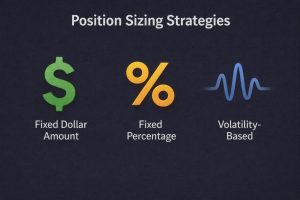
Fixed Dollar Amount
The fixed dollar amount strategy involves risking a set dollar amount on each trade, regardless of the size of your account or the market conditions. This approach is straightforward and easy to implement.
Example: A trader with a $10,000 account might decide to risk $100 on every trade. This means that if the trade goes against them, they will lose $100, regardless of the size of the position.
Pros: Simple and easy to calculate.
Cons: Doesn’t account for account growth or changes in market conditions.
Fixed Percentage of Account Balance
The fixed percentage strategy is one of the most popular position sizing methods. It involves risking a specific percentage of your account balance on each trade. As your account balance changes, so does the amount you risk.
Example: A trader with a $10,000 account might risk 2% per trade. If the account grows to $12,000, the risk per trade increases to $240.
Pros: Scales with your account size, helping to protect capital during drawdowns and take advantage of growth.
Cons: Requires more calculations and adjustments as your account balance changes.
Volatility-Based Position Sizing
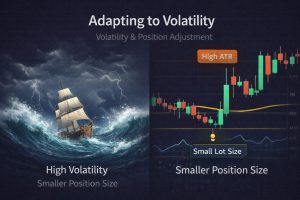
Volatility-based position sizing adjusts the size of your positions based on the volatility of the market. More volatile markets warrant smaller position sizes, while less volatile markets allow for larger positions.
Example: A trader might use the Average True Range (ATR) indicator to measure market volatility. If the ATR is high, indicating increased volatility, the trader reduces the position size to manage risk.
Pros: Adapts to market conditions, helping to manage risk in volatile markets.
Cons: Can be complex to implement and requires ongoing adjustments.
Risk-Based Position Sizing
Risk-based position sizing involves calculating the position size based on the distance between the entry point and the stop-loss level. The further the stop-loss, the smaller the position size, ensuring that the same amount of risk is maintained.
Example: If a trader sets a stop-loss 50 pips away, they calculate the position size so that a 50-pip loss equals their desired risk, such as 1% of their account balance.
Pros: Ensures consistent risk management across trades, regardless of the stop-loss distance.
Cons: Requires precise calculation and discipline to execute consistently.
Kelly Criterion
The Kelly Criterion is a mathematical formula used to determine the optimal position size based on the probability of winning and the reward-to-risk ratio. It aims to maximize long-term growth by adjusting the position size according to the expected value of a trade.
Example: If a trader estimates that their trading system has a 60% win rate with a 2:1 reward-to-risk ratio, they can use the Kelly Criterion to calculate the ideal position size.
Pros: Theoretically maximizes account growth over time.
Cons: Can be risky if not used correctly, as it can suggest large position sizes.

4. How to Choose the Right Position Sizing Strategy
Selecting the appropriate position sizing strategy depends on several factors, including your risk tolerance, account size, and overall trading strategy.
Assessing Your Risk Tolerance
Your risk tolerance is a critical factor in determining which position sizing strategy to use. Some traders are comfortable with higher risk, while others prefer a more conservative approach.
Tip: Consider how much you are willing to lose on a single trade without experiencing undue stress. This will help you decide whether to use a fixed percentage, volatility-based, or risk-based position sizing strategy.
Considering Your Account Size
The size of your trading account influences the position sizing strategy you should use. Smaller accounts might require more conservative sizing to avoid significant drawdowns, while larger accounts can afford to take on more risk.
Tip: If you have a small account, consider using a fixed percentage strategy to protect your capital. For larger accounts, you might experiment with volatility-based or Kelly Criterion sizing to optimize growth.
Aligning with Your Trading Strategy
Your overall trading strategy, including your typical holding period and the market conditions you trade in, should guide your choice of position sizing.
Tip: If you are a day trader operating in highly volatile markets, a volatility-based position sizing strategy might be ideal. If you are a swing trader with a focus on consistent returns, a fixed percentage approach could work better.
5. Case Studies: Applying Position Sizing Strategies in Real Trading Scenarios
Examining real-world examples can help illustrate how different position sizing strategies can be applied in practice.
Case Study 1: Fixed Percentage Strategy for a Conservative Trader
A conservative trader with a $20,000 account decides to risk 1% per trade using the fixed percentage strategy. After identifying a trade setup, they calculate that their stop-loss is 50 pips away. To maintain a 1% risk, they determine that they can trade 0.4 lots. This approach helps the trader protect their capital while still participating in the market.
Case Study 2: Volatility-Based Sizing in a Volatile Market
A trader using volatility-based position sizing notices that the ATR for EUR/USD has increased significantly due to geopolitical events. To manage risk, the trader reduces their position size by half compared to normal market conditions. This strategy helps the trader avoid large losses during a period of high market uncertainty.
6. Common Mistakes to Avoid with Position Sizing
Even with a solid understanding of position sizing strategies, traders can still make mistakes that undermine their performance.
Over-leveraging
Using too much leverage can lead to significant losses, especially if market conditions change unexpectedly. It’s crucial to ensure that your position sizing strategy accounts for leverage and doesn’t expose you to excessive risk.
Avoidance Tip: Stick to a position sizing strategy that aligns with your risk tolerance and avoid the temptation to increase leverage in pursuit of higher returns.
Ignoring Market Conditions
Market conditions can change rapidly, and what works in one environment may not work in another. Failing to adjust your position size based on market volatility or trends can result in unnecessary losses.
Avoidance Tip: Regularly assess market conditions and adjust your position sizing strategy as needed to align with current volatility and market sentiment.
Inconsistent Application of Position Sizing
Consistency is key to successful trading. Inconsistent application of your position sizing strategy, such as changing your risk level based on recent gains or losses, can lead to erratic performance.
Avoidance Tip: Develop a position sizing plan and stick to it, regardless of short-term results. This discipline will help you achieve more consistent trading outcomes over time.
7. Conclusion: Tailoring Positio
 n Sizing to Your Trading Style
Position sizing is a vital component of any successful trading strategy. By understanding the various position sizing methods and selecting the one that best fits your risk tolerance, account size, and trading style, you can significantly enhance your risk management and overall trading performance. Remember, there is no one-size-fits-all approach in trading, and your position sizing strategy should be as unique as your trading goals.
Whether you opt for a simple fixed percentage method or a more complex volatility-based approach, the key is to apply your chosen strategy consistently and adjust it as needed based on market conditions and your evolving trading experience. By doing so, you’ll be better equipped to navigate the Forex market’s challenges and achieve long-term success.
